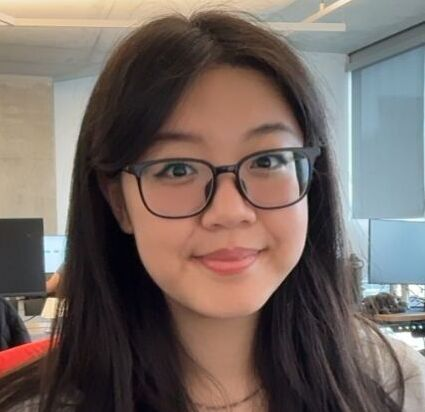
Hey, I’m Yoyo.
I’m a Computer Science (Focus in AI and Technology Leadership) student at the University of Toronto. I am currently completing my 4th year research project Unhobble Science: Building a Model-Adaptive Layer in Chemistry Agents, advised by Professor Alán Aspuru-Guzik and Professor Varinia Bernales.
I recently completed an ML Research Internship at the Acceleration Consortium, where I built agentic infrastructure for self-driving labs, connecting SDL workflows, agentic capabilities, and human control to close the analyze-design gap. I continue to work with AC part-time on reliable agentic reasoning and decision making.
Before that, I was an Applied ML Engineer Intern at Shopify on the Core (Search Relevance) team, a LLM Research Intern at the National University of Singapore, and a research student advised by Professor Anatole von Lilienfeld.
I build machine learning systems that work at the intersection of AI and the natural sciences: RNA structure prediction, drug discovery, protein design, cheminformatics, and molecular modeling.
I care about making ML useful for scientific problems: not just training models, but designing evaluation pipelines, engineering datasets, and building systems that scale. Whether it’s fine-tuning LLMs for metabolite pathway reasoning or implementing inverse-folding benchmarks for protein design, I like getting my hands dirty with the full stack of research engineering.
I’ve been interested in reliability and decision making in agentic systems, reasoning in the chemical space, scientific agents in self-driving labs, and data-efficient learning.
What I’m working on now
- Applying to PhD programs — where I want to take all of this is mapped out below.
- Unhobble Science — building a model-adaptive layer in chemistry agents: how to unhobble a model and move knowledge between harnesses. What is actually transferable across scaffolds, what is scaffold-specific, and what turns out to be unnecessary altogether?
- Acceleration Consortium (part-time) — reliable agentic reasoning and decision making: making an agent’s reasoning trustworthy enough to act on, so it can recognize a bad plan and escalate rather than run it. This grew out of the SDL infrastructure work, narrowed to the reliability question underneath it.
Where I’m headed
In my PhD, I hope to study how to best represent and reason with chemical molecules — though I’m open to other ideas and directions. There are a few layers where this question can be tackled, from “fundamental” chemistry to agentic, cross-discipline work, and every layer feeds the others. Click a node to open it; hover an edge to see how two layers connect.
Research interests
- Reliability and decision making in agentic systems — trajectory-based confidence signals, knowing when a model is out of its depth, and what capability actually transfers between harnesses
- Scalable/Agentic ML systems with reasoning — dataset pipelines, chain-of-thought prompt engineering, latent reasoning in chemical space, custom evaluation frameworks incorporating biochemistry evaluations
- Macromolecule structure prediction and design — 3D folding of ribozymes, data-efficient deep learning approaches for tRNA structure prediction, protein inverse design
- Scientific ML — LLM fine-tuning for bioengineering, molecular energy curve modeling, generative models for conformer prediction
A bit more about me
Outside the lab, I am the co-president of UofT Women in Computer Science (WiCS) and a Student Ambassador for the Department of Computer Science at UofT. I founded the Toronto Ethics in AI Symposium (TEAS) and served as a NCWIT Campus Representative. I also sing, play double bass and make jewelry. I love watching old Sci-Fi movies :D
Feel free to reach out if you’re working on AI for science, or if you just want to chat about research.